
Shopping for a best circular saw for the money means sorting through motor ratings, sizes, and features that all sound important, and the differences only become clear once the tool is in hand. This article walks through what matters for straight cuts in plywood, framing lumber, and sheet goods, how to match a model to the job, and which trade-offs are worth accepting. The six models in the Related products section below cover the main options, from compact corded models to cordless versions, so the choice comes down to the work, not the sales pitch.
Size and Capacity
Start with the size of the work you do most often. A circular saw that is too small will force extra passes and awkward setups, while one that is too large can feel clumsy on small pieces and hard to store. Measure the thickest material you work with on a regular basis, then check that the tool can handle that thickness with room to spare. A 7-1/4-inch blade is the common size for general work, because it cuts through standard two-by lumber in a single pass while staying light enough to guide with one hand. Smaller blades suit trim and thin sheet goods, while larger blades handle thicker stock but add weight and cost.
Before buying, measure the boards and panels already waiting in the shop. A tool that matches those sizes will handle most jobs without extra setup, while a tool bought for one imagined job may sit unused. If the work varies widely, a mid-size model with adjustable settings covers more ground than a large model built for a single task.
Power and Speed
Power sets how easily the tool moves through dense material without slowing down. Corded models in the 13- to 15-amp range handle long rip cuts without slowing down, while 18-volt and 20-volt cordless models trade some sustained power for freedom from outlets. Check the no-load speed as well, since a higher speed usually means a cleaner edge in plywood and a faster cut in framing lumber. For most home workshops, a mid-range motor covers the common jobs, and stepping up makes sense only when the work is heavy or constant. A tool that bogs down in the cut usually needs a sharper blade first, not a stronger motor.
Speed ratings and amp ratings work together, and neither tells the whole story alone. A fast motor with a dull blade still cuts slowly, while a sharp blade on a modest motor often finishes the job cleanly. Keep spare blades on hand, and the power the tool already has will go further.
Corded or Cordless
The corded versus cordless choice shapes how the tool fits a workday. Corded saws run as long as the job lasts and suit workshop and framing work near power. Cordless saws shine on roofs, decks, and remote sites where dragging a cord wastes time, but they need charged batteries on hand and spares ready for swapping during a long day. Think about where the work happens most often, how long each session runs, and whether batteries are already part of the workshop. Owners who already own batteries from the same system often get more value from a cordless model.
Battery platforms matter for cordless models, because a battery that fits other tools in the shop is worth more than a slightly stronger motor. For corded models, check the cord length and where the outlet sits relative to the bench. A short cord with an extension cord is workable, but a cord that crosses the work area is a trip hazard.
Comfort, Weight, and Control
Comfort decides whether a tool gets used for long sessions or left on the shelf. A comfortable grip matters more than it looks on paper, because a circular saw is guided by hand for every cut. Look for a rubber overmolded handle, a balanced feel when the saw rests on the workpiece, and a shoe that sits flat without rocking. Hold the tool the way it will be used on the job, not just in the store, and check that switches and locks fall under the fingers without shifting the grip. A few minutes of handling before buying can prevent months of frustration.
Vibration and noise add up over a long session, so a tool that feels calm in the hand is worth a closer look. Try the grip with gloves on if that is how the work is done, and check that the weight sits over the work rather than pulling to one side. Small design details, like a well placed switch, show up after the first hour of use.
Dust Collection and a Cleaner Workspace
Dust and debris are part of every job with a circular saw, and managing them keeps the work accurate and the shop cleaner. Sawdust builds up fast during rip cuts, and it hides the cut line if it is not cleared. Some saws include a dust port or a collection bag, and many accept a shop vacuum hose. Even without a port, blowing the line clear between cuts keeps the work accurate. A clean cut line is easier to follow, and a clean surface takes a finish better, so dust control is worth the small effort it takes.
A vacuum hose or a dust bag adds a step to setup, but it pays off in cleaner cuts and a healthier shop. Fine dust gets into finishes, tools, and lungs, so even a simple bag is better than none. For indoor work, set up dust control before the first cut, not after the room is already coated.
Common Mistakes to Avoid
Most problems with a circular saw come from habits rather than from the tool itself. The most common mistake is forcing the saw through the cut instead of letting the blade do the work, which overheats the blade and leaves burn marks. Other frequent errors include cutting with a dull blade, setting the depth too deep, and starting a cut before the blade reaches full speed. Slow down on the first cuts with a new tool, watch how the material responds, and adjust speed and pressure before the job is half done. A short practice run on scrap material often saves a ruined workpiece.
Another mistake is buying on a single feature, like top speed, and ignoring the rest of the tool. Speed, size, comfort, and dust control all shape the result, and a balanced model usually beats a model that excels in one area and falls short in the others. Read the full picture before deciding.
Frequently Asked Questions
People often ask whether a cordless circular saw can replace a corded one. For occasional cuts and punch-list work, a modern cordless saw handles the job well. For all-day framing or repeated rip cuts, a corded saw stays stronger for longer. Another common question is how often to change the blade, and the answer is to change it when cuts slow down, the edge burns, or teeth show damage. When in doubt, start with a mid-range model that covers the common jobs, learn how it behaves on scrap material, and add specialized blades as the work demands them.
One more point deserves attention: the right circular saw is the one that fits the work, the space, and the hands that will use it. A model that is too large for the bench or too heavy for long sessions will not get used, no matter how strong its motor looks on paper. Compare the six models below with those practical limits in mind, and the choice usually narrows to one or two clear options.
Related products
The six models below cover the main options for this kind of work. Compare size, power, and comfort against the job at hand, and check that replacement blades are easy to find before deciding.
SKIL 13-Amp 7-1/4-Inch Circular Saw

- A 13-amp motor supplies steady power for long straight cuts in sheet goods and framing lumber.
- The bevel adjusts to 51 degrees with positive stops, so angled cuts stay repeatable.
- A spindle lock makes blade changes quick, and the reduced weight helps limit fatigue on longer jobs.
DEWALT 20V MAX Cordless Circular Saw

- The motor runs at 5,150 RPM for fast cuts without a cord holding the saw to an outlet.
- A high-strength magnesium shoe keeps the base light while holding cut accuracy over time.
- The rubber overmolded grip improves balance and control, and the bevel capacity reaches 50 degrees.
DEKOPRO 1200W Corded Circular Saw
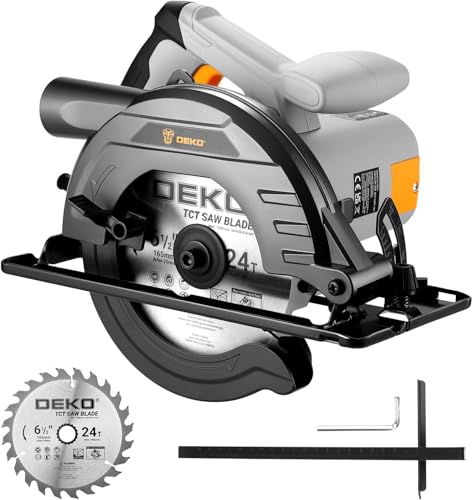
- A 1,200-watt motor runs at 4,800 RPM for steady cuts through wood and PVC.
- Cut depth adjusts to 55 millimeters at 90 degrees and 33 millimeters at 45 degrees on a steel base plate.
- The included 165-millimeter 24-tooth blade cuts smoothly, and a double protection switch helps prevent accidental starts.
Milwaukee M18 Brushless 7-1/4-Inch Circular Saw

- An 18-volt brushless cordless motor drives a 7-1/4-inch blade for cuts away from an outlet.
- The brushless design runs efficiently on the M18 battery platform for longer working sessions.
- It arrives as a tool-only model, so it suits owners who already have compatible batteries and a charger.
GALAX PRO 11-Amp Circular Saw

- An 11-amp, 1,400-watt copper wire motor reaches 6,000 RPM for cuts in wood, plastic, tile, and soft metal.
- Cut depth adjusts freely, reaching 2-7/16 inches at 90 degrees and 1-13/16 inches at 45 degrees.
- A dual switch design guards against unexpected starts, and a scale ruler helps keep long cuts straight.
Makita 7-1/4-Inch Circular Saw 5007F

- A 15-amp motor delivers 5,800 RPM for steady performance on demanding cuts.
- The lower guard design helps with bevel and narrow cuts, and cutting capacity reaches 2-3/8 inches at 90 degrees.
- Two built-in LED lights illuminate the line of cut for better accuracy in dim work areas.
Prime covers fast, free delivery on eligible items. See whether a Prime free trial is available for your account.
Check Prime on Amazon →



Write Your Review
No reviews yet. Be the first to share your experience!