
A circular saw turns a stack of boards and sheets into finished pieces with straight, fast cuts. This article explains blade size, bevel, cutting depth, and corded versus cordless power in plain terms, then gathers six saws that cover the common jobs in a home workshop. Each one is described from its own stated features, so the comparison stays grounded in what each saw offers. The sections below cover blade size, tooth count, bevel, and cutting depth, plus corded and cordless power, dust control, safety, and the care that keeps a saw cutting cleanly.
Signs It Is Time for a New Circular Saw
A saw that loses power on easy cuts, or a motor that smells hot after short work, is showing its age. A guard that sticks, a shoe that no longer sits flat, or a blade that wobbles despite a firm bolt are all signs of wear. When the tool struggles on jobs it once handled easily, it is time to look at a replacement.
Age alone is not a reason to replace a saw that still cuts well. But when parts are hard to find, or when a cordless battery system no longer matches other tools in the house, an upgrade makes sense. A new saw with a sharp blade and a fresh battery often costs less than chasing parts for an old one.
Keeping a Circular Saw in Good Shape
A circular saw lasts longer when it stays clean. Brush sawdust off the body after use, and clear the guard so it moves freely. Keep the vents clear on corded models, because a motor that cannot breathe runs hotter and wears faster. A quick wipe takes a minute and keeps the tool ready for the next job.
Store the saw on a dry shelf or in its case, with the blade covered. Check the shoe for flatness and the guard for smooth movement from time to time. Small habits like these add years to a tool that handles hundreds of cuts.
How to Clean a Circular Saw
Cleaning a circular saw starts with unplugging it or removing the battery. Brush sawdust off the body with a dry brush, paying attention to the guard, the shoe, and the vents. A damp cloth handles grime on the grip, but water should never get inside the motor housing.
Check the lower guard moves freely and snaps back over the blade, and wipe the blade dry so it does not rust. Clear dust from the collection port where fitted. A clean saw guards better, runs cooler, and stays ready to use.
Staying Safe With a Circular Saw
A circular saw demands respect. Keep both hands on the tool, keep the cord or battery clear of the cut line, and never reach under the board while the blade spins. The lower guard should snap back over the blade as soon as the cut ends, so check that it moves freely before each session.
Clamp the workpiece so it cannot move, and support the offcut so it does not pinch the blade as the cut finishes. A pinched blade kicks back, which is the most common cause of accidents with this tool. Safety glasses and hearing protection are worth wearing on every cut, not just the long ones.
Changing Blades and Keeping Them Sharp
Blade changes are part of owning a circular saw. A spindle lock holds the blade still while the bolt is loosened, and the new blade must face the right way, with its teeth pointing in the direction of rotation. Tighten the bolt firmly, then spin the blade by hand to check it runs true.
A dull blade burns wood, needs more push, and leaves a rough edge. Replace or sharpen it when cuts slow down or the edge starts to scorch. Keep blades in a case so their teeth stay sharp, and match the blade to the material: wood blades for lumber, and the right blade for plastic, tile, or soft metal.
Common Mistakes to Avoid
The most common mistake is cutting without a guide on a long rip, which leaves a wandering line. Another is setting the blade too deep, which exposes more blade than the cut needs. A third is pushing the saw too hard, which stalls the motor and burns the wood. Let the blade cut at its own pace.
Forgetting to support the offcut is another costly error, because a pinched blade kicks back. Buying a saw without checking whether the battery is included leads to a stalled project on day one. A short pause before buying, to check what the kit actually includes, avoids most of these problems.
Getting Good Value From a Circular Saw
Value in a circular saw comes from matching the tool to the work. A corded saw with a strong motor suits a workshop with outlets nearby, while a cordless model suits site work with no power. Check whether the battery is included, what blade comes in the box, and whether a case is included before comparing one saw with another.
Think about the jobs ahead, not just the first one. A saw that cuts plywood for shelves today should also handle deck boards and framing next year. A saw that grows with the household gives more value over its life than a cheaper model that needs extras right away.
Frequently Asked Questions
Here are short answers to the questions people ask most about circular saws.
How long does a circular saw last?
With regular use and basic care, a circular saw can serve for many years. Blades wear out far sooner than motors, so a saw with easy blade changes and a solid shoe lasts longer in practice.
Can a circular saw cut tile or soft metal?
Some models can, with the right blade. The key is matching the blade to the material and cutting at a steady pace, rather than forcing the saw through the work.
Corded or cordless: which should I choose?
Corded suits a workshop with outlets nearby and long cutting sessions. Cordless suits site work and quick cuts away from power, especially when batteries on the same battery system are already on hand.
Putting It All Together
Start with the cuts on the list for the next few months, then match the saw to those jobs. A saw with the right blade size, a clear cut line, and a smooth guard covers most workshop work, while a guide or straight edge keeps long rips true. Check what each saw includes before deciding, because the blade and battery in the box matter as much as the tool itself.
Once the saw arrives, check the guard movement, set the depth on scrap wood, and make a few test cuts with a guide clamped in place. A few minutes of practice builds the feel for feed speed and bevel settings, and that feel carries into every job after. The six saws below give a solid starting point for comparing what each one offers.
Related products
Six options follow, each described from its own stated features.
Makita 15 Amp 7-1/4 Inch Circular Saw

- A 15-amp motor delivers 5,800 rpm for proven performance and jobsite durability.
- Cutting capacity reaches 2-3/8 inches at 90 degrees and 1-3/4 inches at 45 degrees.
- Two built-in LED lights light the line of cut for accuracy, and the lower guard design helps with bevel and narrow cuts.
SKIL 13-Amp 7-1/4 Inch Circular Saw

- A 13-amp motor gives more power and performance than the SKIL 5380.
- The saw weighs 15 percent less than the SKIL 5380, which helps reduce user fatigue.
- A 51-degree bevel with positive stops adds cut capacity, and a spindle lock makes blade changes easy.
DEWALT 20V MAX Circular Saw

- The motor runs at 5,150 rpm for power and speed on demanding cuts.
- A high-strength, lightweight magnesium shoe gives jobsite durability and long-term cut accuracy.
- The 0-50 degree bevel capacity covers aggressive bevel cuts, and the rubber over-molded grip gives balance and control. The battery is not included.
DEKOPRO 1200W Circular Saw With 165mm Blade
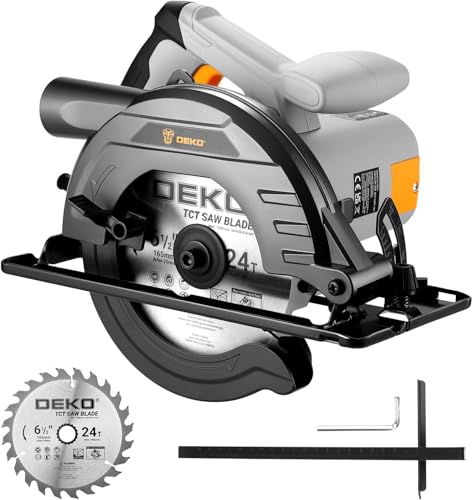
- A 1,200W motor delivers 4,800 rpm for cuts through wood and PVC.
- Cut depth adjusts to 55mm at 90 degrees and 33mm at 45 degrees, with a steel base plate for durability.
- The 165mm 24-tooth blade cuts smoothly, a hex wrench is included for blade changes, and a double protection switch helps prevent accidental starts.
Milwaukee M18 Brushless 7-1/4 Inch Circular Saw

- An 18V lithium-ion brushless cordless saw with a 7-1/4 inch blade.
- This is a tool-only model, so the battery and charger are not included.
GALAX PRO 11A Circular Saw With Dust Collection

- An 11-amp, 1,400W copper wire motor runs at 6,000 rpm with no load for cutting wood, plastic, tile, and soft metal.
- Cut depth reaches 2-7/16 inches at 90 degrees and 1-13/16 inches at 45 degrees, with a bevel angle adjustable from 0 to 45 degrees.
- A dual insurance switch helps avoid unexpected starts, and a scale ruler helps keep cuts straight.
Prime covers fast, free delivery on eligible items. See whether a Prime free trial is available for your account.
Check Prime on Amazon →



Write Your Review
No reviews yet. Be the first to share your experience!